
Andhra Pradesh chief minister-designate N Chandrababu Naidu on Friday met Prime Minister Narendra Modi and demanded special category status for the residual state.

Andhra Pradesh will establish two expansive integrated space cities in Lepakshi and Tirupati, spanning around 33,000 acres.
'To encourage the habit of saving, a portion of the incentive will be kept in a savings instrument of deposit account for a fixed period and can be withdrawn by the employee at a later date.'

The Rs 20 lakh crore package includes Rs 1.7 lakh crore package of free foodgrains to the poor and cash to poor women and elderly, announced in March, as well as the Reserve Bank's liquidity measures and interest rate cuts.

When missiles fly in this region, they are never just aimed at military targets.

State governments have requested the Centre for export incentives, lifting of import duty in the case of cotton for the textile sector and GST exemptions.
The Union Cabinet on Wednesday approved a Rs 76,000 crore policy boost for semiconductor and display manufacturing ecosystem in the country in an bid to position India as a global hub for hi-tech production. Announcing the decision of the Cabinet, IT and Telecom Minister Ashwini Vaishnaw observed that electronics plays an important role in everyday life, and semiconductor chips forms a crucial part of electronics. Outlining the details of the scheme, he said the Rs 76,000 crore programme has been approved for the development of semiconductors and display manufacturing ecosystem.

'The package will help in realising the true potential of employment generation in the textile and apparel sector.'

'Why has Maharashtra slipped up over the past couple of decades?' 'Not only is this question critical for residents of the state, but given that it accounts for 14% of India's GDP, a faster-growing Maharashtra implies a faster-growing India as well, point out Shishir Gupta and Rishita Sachdeva.

In a double-dose bid to boost growth and employment prospects, the Union Cabinet on Tuesday approved a Rs 2.07 trillion outlay for a research development and innovation (RDI) Scheme to fund private sector innovations, and an employment-linked incentive (ELI) to create over 35 million new jobs over the next two years.

A major fire broke out in Britannia Industries' Pantnagar manufacturing plant on Sunday destroying thousands of tons of biscuits. However, no one was killed or injured in the fire which broke out around 1230 hours in the biscuit division of the factory, Senior Superintendent of Police (SSP) Udhamsingh Nagar (district) Manjunath T C told Business Standard after the firefighters put the fire out. "With the help of 15-20 fire tenders, we were able to control the fire which was very major," Manjunath said.
Union Finance Minister Arun Jaitley on Friday assured Chief Minister-designate N Chandrababu Naidu that all commitments made to residual Andhra Pradesh will be fulfilled.

Domestic supply of electronics is already less than half of domestic dem#8743 and although it is growing at 16 per cent already, demand is growing much faster.

Unlike the previous visit, where TDP MPs accompanied Naidu to meetings, sources termed the current visit as "low profile", with one-on-one meetings with key Union ministers.
Finance Minister Nirmala Sitharaman on Tuesday announced income tax relief for the middle class, a Rs 2 lakh crore outlay for job creation schemes over the next five years and a spending splurge for states run by her party's new coalition partners as she unveiled the Modi 3.0 government's first budget after the general elections.

According to an Andhra government statement, Naidu 'reposed confidence' in the PM's leadership.

Congress on Monday announced a slew of populist measures including sops to farmers, students, unemployed youths, minorities, raising subsidised LPG cylinders from 9 to 12 and constitution of Vidhan Parishad in its manifesto for the Madhya Pradesh assembly elections.

A team of more than 60 people under Neeraj Mittal, an IAS officer, was instrumental in getting up the New Industrial Policy 2021 targeting investments of around Rs 10 trillion by 2025.

Is self-reliance the right approach in a mega-buck game, or better to be part of a network? asks T N Ninan.
The government has given an 'in-principle' approval to the special incentive package prepared by the department of information technology for semiconductor manufacturing and other high-tech industries.

A rare bonhomie among three private telecom companies in raising tariffs coming on the back of a bailout package by the government may have helped the telecom sector avert a crisis but the challenges haven't ceased to exist as the industry faces a cash-guzzling task of rolling out 5G networks in the coming months. The sector that provides direct and indirect employment to millions is projected to see Rs 1.3 lakh crore to Rs 2.3 lakh crore of investments in the coming years in creating robust infrastructure and building telecom and network products that have been incentivised by the government through PLI and other initiatives. After years of cut-throat competition and the apex court ruling on payment of past statutory dues left some players in the lurch, billionaire Sunil Mittal's Bharti Airtel and struggling Vodafone Idea almost in tandem raised tariffs, taking the plunge they had long been talking about.
The government on Wednesday cleared a major central legislation to provide duty free environment, single window clearance and more tax incentives to special economic zones to make exports the engine of economic growth.

The challenge is to convince productive sectors that a lower general rate would benefit all and remove the prevalent system of favours targeted towards narrow industry and service sector groups.

Apple and Samsung are international players and should work as a team with domestic companies to transform India into a global powerhouse: IT Minister Ravi Shankar Prasad.

The government has merged the Department of Public Enterprises (DPE) with the finance ministry to give it a better control over state-owned firms and facilitate its ambitious privatisation programme. Finance ministry will now have six departments while DPE's hereto parent ministry, the ministry of heavy industries and public enterprises will now be called the ministry of heavy industries. Previously, the disinvestment ministry - created under the Atal Bihari Vajpayee government - was merged with the finance ministry and is now a department under it. Also, Foreign Investment Promotion Board (FIPB) was abolished and administration of foreign investments was given to the finance ministry (FinMin).

But it may come with a downside risk of further rise in prices of several products.
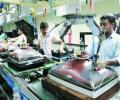
'The government expects demand for electronic products to reach $400 billion by 2023-24. This would be a huge foreign exchange outflow, which may further widen our trade deficit with other nations. Hence, the government plans to push local electronics manufacturing to cut down on their import bill.'
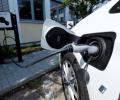
The government will create an EV Venture Capital Fund, for financial support to start-ups in the segment. The overall aim is to make Tamil Nadu the preferred destination for EVs and component makers.
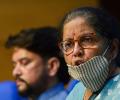
Later, there may be some tax relief aimed at the middle class and measures to benefit the sectors worst hit by Covid-19 and the resultant nationwide lockdown.

Sundays are generally quiet days for air travel, but this Sunday was a tad different. There was quite an excitement at Gate 28 of Mumbai airport's Terminal 1 as Akasa Air, India's newest airline, prepared to take to the skies on Day 1. With a new fuel-efficient Boeing 737 Max aircraft and soft cushioned seats equipped with USB ports, Akasa Air hopes to bring freshness to the flying experience.

It, however, does not manufacture devices on its own and rather does it through contract manufacturers.
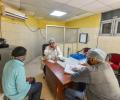
The current crisis has forced the government to announce measures to ensure that India becomes self-sustaining for any kind of bulk drug. The government says India will not depend on any other country for vital key ingredients for drugs within six years, reports Sheela Bhatt.
As India emerges from the COVID-19 crisis, the ninth budget under the Modi government, including an interim one, is widely expected to focus on boosting spending on job creation and rural development, generous allocations for development schemes, putting more money in the hands of the average taxpayer and easing rules to attract foreign investments.

Increasing the duties on auto parts and putting an additional cess on petrol and diesel could drive up costs of vehicles, specially where volumes are low and localisation is not viable.
The government announced several incentives in the five-year Foreign Trade Policy.

Narendra Modi might on Saturday ask the Apple CEO to make in India instead of importing and selling refurbished phones

In the second of a four-part series, Business Standard checks out the currency press in Dewas to find target-based allowances have increased the monthly salary of employees from Rs 10,000 to Rs 30,000, at a time when notes are being printed 24x7.

As many as 24 special economic zone (SEZ) developers including Dr Reddy's Lab and Tata Consultancy Services have sought more time from the government to execute their projects.
For the past few weeks, the government has been in an overdrive, pushing stuck projects with the larger aim to improve the country's economic growth, which had fallen to a four-year low of 4.4 per cent in the first quarter of this financial year.
